Trending Today
Welcome to the Department of Education

The Department of Education of the college is one of the oldest ones having completed eleventh years of Honours teaching. The young Department has a wonderful past and very enthusiastic present paving the way for the impressive days of the future. It nurtures the untamed youth that manifests itself in diverse forms. The distinguished professors who have served or are serving this department over the years, try to make a safe haven for learning and cooperation. A lively academic and cultural ambience and a very cordial teacher-pupil relationship have always been and hopefully will be the distinctive characteristic of the department. Due to severe shortage of funds and space the department does not have a separate seminar/departmental library but the central library has more than 500 titles dedicated to Education studies. Within the strict, limited capacity the department tries to organize students’ seminar, workshops and movie screenings to facilitate the students.

HOD Message

Education is not the learning of facts, but the training of the mind to think.

 —Albert Einstein

The department of Education  was started in 2012 as general course in our college. Then in 2013 honours course was introduced. The department is decked with 4 faculty members and with a good strength of students. It focuses upon the good academic performance and gives almost importance to active learning in the form of discussion, presentation, seminar and special talk.

Our aim is to make them well established in their future life and good human being. Most of the students come to class everyday in spite of many problems from their rural areas. Even students are encouraged to participate in activities other than their curriculum like NSS. several cultural activities and sports among other things.

Above all, the department has tried to move from a traditional formal student- teacher relationship to a more informal ‘friend- philosopher- guide’ equation. The approach has not been solely disciplinarian one but has been a more humane relationship enabling creativity to blossom keeping the spirit of education and life intact.

Noticeboard
Detailed Information
The Department of Education of the college is one of the oldest ones. The department started working with the beginning of the college. Gradually the various undergraduate courses were drafted into the department as per the rules of UGC and Vidyasagar University. Currently the department offers both Major and Minor courses in B.A. Education under CCFUP.
Sl. No. Course Offered Year of Inception
1 B.A. General 2012 
B.A. Honours 2013 
B.A. General (3 Tier Exam Pattern) 2014 
B.A. Honours (3 Tier Exam Pattern) 2014 
2 B. A. Honours (CBCS ) 2018
B.A. General (CBCS ) 2018
3 CCFUP, 2023 Major 2023
CCFUP, 2023 MDC 2023

Education have been an integral part of the courses offered in various universities in India since pre-Independence days. Since the inception of Vidyasagar University, this course has been introduced in the undergraduate courses in constituent colleges and the syllabus in Education concept of Education and factors. Different points of the syllabus have incorporated ideas, events, personalities, and texts that formed the backbone of each period with clear awareness of parallel or related trends in the continent. The courses also have been designed to acquaint the students with the history of the Education, Educational system and Education in India During ancient and medieval period, British period, and after independence.

Keeping the above view in mind our department try-

  • To provide all information regarding the scope and opportunities of this subject.
  • To impart the lessons in such a way that the students feel they always surrounded by economic phenomenon in their day-to-day life.
  • To make students more equipped with this subject by taking class seminars, class test and by completion of syllabus in due time.
  • To make the knowledge perfect and matured and attain finality
  • To work as consultants/mentors by the teachers to help the students to fulfill their dream and to motivate them to become ideal human being.
  • To make the students more disciplined and punctual, the teachers act as friend, philosopher and guide.
  • To encourage students to take part in co-curricular activities such as sports, NSS, arts, music and other cultural competitions and to do short courses on Computer Training, Communication English to enhance their self-confidence.

At present the intake capacity of our department at UG Honours level is 76. The distributions of these 76 seats are presented in following table.


Sl. No. Caste Category Intake Capacity
1General 33 
2General PH02
3SC 16 
4SC- PH01
5ST 04
6ST-PH00
7OBC-A 08 
8OBC-A PH00
9OBC-B 05 
10OBC-B PH00
11EWS 08 
12EWS- PH00
Total 77

Though the admission in the department is done on merit basis, but keeping in view the concept of globalization, the age of electronic media, the best utilization of human resources and social need of the day, students hailed from underprivileged class of this district, have been given special consideration during admission. Apart from this, students having distinction in sports, fine arts, music and students hailing from the adjoining area of the locality of the college, get opportunity to take higher education in this college. The complete admission procedure is online and it adheres to the rules and regulations of Vidyasgar University and the Higher Education Dept., Govt. of West Bengal.

The infrastructure facilities of our department is presented below

  • No separate departmental class room for lack of space.
  • One ICT enabled class room
  • No separate departmental library but central library caters to the needs of the students.

Year wise Student enrolment (Hons) during 2018-19 to 2022-23

Year Enrolment Gen SC ST OBC-A OBC-B GEN-PHSC-PHTotal
2018-19623513030604010062
2019-20623313040604010162
2020-21623213040604020162
2021-22623213040604020162
2022-23623213040604020162


Academic Performance of the Students:

The performance of the students in final examination for the last five years is given in the following table –

Year Appeared Passed Percentage
2018-193333100
2019-202929100
2020-214747100
2021-223434100
2022-232828100
MethodsTechniques
Traditional MethodsLecture Method, chalk and talk Method
Student-Centered MethodsDiscussion Method, Project Method, Group Discussion, Problem Solving Method
Collaborative MethodsTeam teaching, Cooperative Learning Method, Peer Instruction Method
Special Needs MethodsIndividualized Education Program, Tutorial Method
Technology-Integrated MethodsPowerPoint Presentation with projector

The Education (Hons.) undergraduate course is designed to introduce students with the various traditions of Education in India during ancient and ancient and medieval period. The different courses of the Education undergraduate Programme is created History of Indian Education, The Programme tries to make the students understand the different periods of education, after independence, educational organization, management, planning. It tries to focus on Literary/Cultural studies which help to develop intellectual acumen and a better understanding of human life and experience. 

  • The new UG syllabus under CBCS also includes Indian classical educational system, Indian philosophical foundation and psychological foundation. The main rationale of the Programme is to acquaint students, who have just stepped in to the threshold of higher education, with an overall idea of literature, develop their critical insights, understand the reception of texts and make them familiar with scholarly methodology.
  • The new syllabus of studying literary and cultural texts is structured in such ways that it helps students think deeply about socio cultural issues of race and gender. It helps to develop the reasoning faculty of the mind and understand the cross cultural issues of influence and reception.
  • The Programme also helps to develop skills of educational Research and Educational Statistics
  • The Programme also helps to develop skills of ICT & e-learning.
  • The Programme also helps to develop skills of Project based learning, co-operative learning
  • students in good stead in the job market.

Four fulltime state aided college teachers.

Sl.
No.
Name of the
teachers
DesignationDate of joining Teaching
experience
Highest
qualification
Specialization
1Smt. Soma PatraSACT-II05.09.201212 Yrs.M.A.

1.Educational Technology

2.Mental Hygiene and Child Guidance

2Mr. Sibaprasad MaitySACT-II13.01.201410 Yrs.M.A., SET Qualified1. Guidance and Counselling
3Mr. Kanailal MaitySACT-II25.09.20186 Yrs.M.A.

1. History of Education

2. Mental Health, Mental Hygiene

4Mr. Snehasish DolaiSACT-II25.09.20186Yrs.M.A.

1. Psychology

2. Environmental Education

Total 50classes per week are allotted for both general and honours course. Out of these, 39 are honours classes and 20 are general/Generic Elective classes. The workload of the faculty members is given below
Sl. No. Name of the teachers Class allotted (Hons.) Class allotted (General) Total
1 Mrs. Soma Patra  09 6  15
2 Mr. Sibaprasad Maity  10 4  14
3 Mr. Kanailal Maity  10 5 15
4 Mr.Snehasish Dolai 10 5 15

Teaching Plan under CCFUP

Teaching Plan (Honours Courses)
SemesterSemester ISemester-II
Name of the TeacherMJ1SEC1P MI1MJ2SEC2P 


Teaching Plan:

Teaching Plan under CBCS

Teaching Plan (Honours Courses)
SemesterSemester ISemester-IIISemester V
Name of the TeacherCC1CC2GE1CC5CC6CC7SEC1GE-2CC11CC12DSE1DSE2
Soma PatraUnite-1Unite-4 Unite-2Unite-1Unite-3&4Unite-2Unite-1Unite-2Unite-2Unite-3 
Sibaprasad MaityUnite-4Unite-2Unite-1&2Unite-3Unite-4 Unite-4Unite-2Unite-3Unite-1Unite-2Unite-2&4
Kanailal MaityUnite-2Unite-3Unite-3Unite-1Unite-3Unite-1Unite-1Unite-3Unite-1Unite-1Unite-4Unite-1
Snehasish DolaiUnite-3Unite-1Unite-4Unite-4Unite-2Unite-2Unite-3Unite-4Unite-4Unite-3Unite-1Unite-3
SemesterSemester IISemester IVSemester VI
Name of the TeacherCC3CC4GE2CC8CC9CC10SEC2GE-4CC13CC14DSE3DSE4
Soma PatraUnite-4Unite-1Unite-1Unite-2Unite-3Unite-3Unite-3Unite-1Unite-3Unite-1Unite-4Unite-3
Sibaprasad MaityUnite-2Unite-4Unite-4Unite-3Unite-4Unite-2Unite-2Unite-2Unite-4Unite-3&4Unite-3Unite-2
Kanailal MaityUnite-3Unite-2Unite-2Unite-4Unite-1Unite-1Unite-1Unite-3Unite-1Unite-2Unite-2Unite-1
Snehasish DolaiUnite-1Unite-3Unite-3   –Unite-1Unite-2Unite-4 Unite-4Unite-2 Unite-1Unite-4
Teaching Plan ( General Courses)
SemesterSemester- ISemester- IIISemester- V
Name of the TeacherDSC-1ADSC-3ASEC-1DSE-1AGE-1SEC-3
Soma PatraUnite-1Unite-3Unite-1Unite-1Unite-1Unite-1
Sibaprasad MaityUnite-3Unite-2Unite-2Unite-2Unite-2Unite-2
Kanailal MaityUnite-2Unite-1Unite-3Unite-4Unite-Unite-3
Snehasis DolaiUnite-4Unite-4Unite-4Unite-3Unite-3Unite-4
Sem.Semester- IISemester- IVSemester- VI
Name of the TeacherDSC-2ADSC-4ASEC-2DSE-2GE-2SEC-4
Soma PatraUnite-1Unite-4Unite-1Unite-1Unite-3Unite-1
Sibaprasad MaityUnite-3Unite-3Unite-3Unite-2Unite-2Unite-2
Kanailal MaityUnite-2&4Unite-1Unite-2Unite-4Unite-4Unite-3
Snehasis DolaiUnite-5Unite-2Unite-4Unite-3Unite-1Unite-4


Syllabus distribution under CCFUP

Syllabus distribution (Honours Courses)

Sl. No.Name of the TeacherSemesterAssigned parts of the Syllabus for Honours courses  
1Soma Patra    I

MJ – 1T: Philosophical Foundation of Education

Child/learner influence of heredity and environment on the learner.Teacher qualities and duties of a good teacher Curriculum and co-curricular activities – concept, types and significance of co-curricular activities. Educational institutions informal, formal and non-formal, their interrelation.

   
2Sibaprasad Maity

MJ – 1T: Philosophical Foundation of Education

Philosophy: Concept and branches

Western Philosophical thoughts and their influence on Education – Idealism, Naturalism, Pragmatism and Realism. Indian Philosophical thoughts and their influence on Education – Samkhya, Yoga, Buddhism Jainism and Islamic

   
3Kanailal Maity

MJ – 1T: Philosophical Foundation of Education

Meaning, nature, scope, and aims of Education.

Individualistic and socialistic aim (meaning, characteristics, and difference) Report of Delor’s Commission (UNESCO, 1996) Educational Philosophy: Meaning, nature, scope, and relation between education and philosophy.

   
4Snehasish Dolai

MJ – 1T: Philosophical Foundation of Education

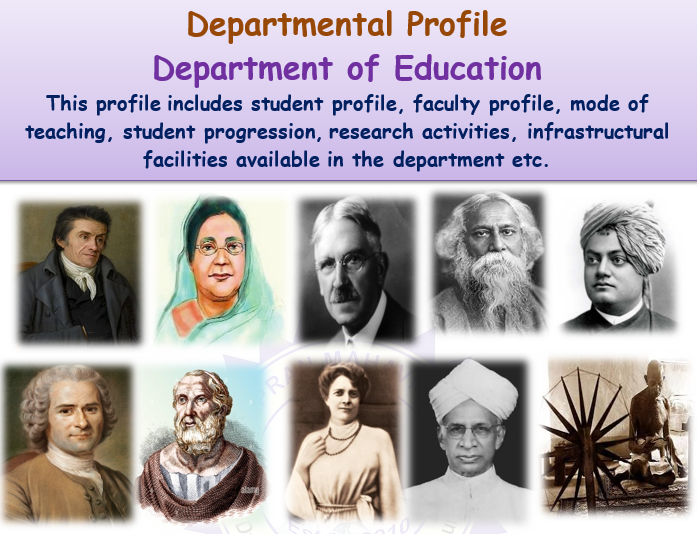
Great Educators and Education (w.r.t Aims, Curriculum, Method of Teaching) Rabindranath Tagore, Swami Vivekananda, John Dewey, Bertrand Russell

   
1

Soma Patra

Sibaprasad Maity

Kanailal Maity

Snehasish Dolai

I

SEC1P: Institutional Survey

In an Institutional Survey, Students may cover any four of the following areas of the Institution and can follow either qualitative or quantitative or mix method of analysis for preparing the report of the Institution. Report should be within 5000 words (A4 pages) and to be submitted as per University Schedule

   
1Kanailal MaityI

MI-1: Introduction to education

The narrow and broader concept of education.

Education as process and product, as Science and Arts. Meaning, nature, and scope of education. Aims of education-individual, social, vocational, and democratic. Aims of modern education with special reference to Delor’s Commission

   
2Soma Patra

MI-1: Introduction to education

Child/learner influence of heredity and environment on the learner. Teacher qualities and duties of a good teacher. Curriculum-concept, and types. Co-curricular activities meaning, values, and significance. Educational institutions informal, formal, and non-formal, their interrelation

   
3Snehasish Dolai

MI-1: Introduction to education

Agencies of Education Such as Home, School, State, Mass media-television, radio, cinema, and newspaper


4Sibaprasad Maity

MI-1: Introduction to education

Child Centricism and Play-way in Education.

Concept of child-centricism in education. Characteristics and significance of child centralism in education. Concept of play and work. Characteristics of play way in Education. Kindergarten, Montessori, Project method.

   
1Soma PatraII

MJ – 2T: Psychological  Foundation of Education

Relation between Psychology and Education

Meaning and Definition of Education and Psychology, and their relationship.

Relation between Education and Psychology

Nature and Scope of educational Psychology

Methods of Educational Psychology

   
2Sibaprasad Maity

MJ – 2T: Psychological  Foundation of Education

Stages and Types of Hun in development and their educational significance

Piaget’s cognitive development  sent theory

Erikson’s psycho-social development theory

Kohlberg’s moral development theory

Personality Concept, Types and development.

   
3Kanailal Maity

MJ – 2T: Psychological  Foundation of Education

Intelligence & Creativity such as Intelligence: Concept and Nature, Theories of Intelligence as d their implications-Spearman, Thurston, Guilford and Gardner. Measurement of Intelligence verbal, non-verbal, and performance tests, Emotional Intelligence Concept and Nature, Creativity: meaning, nature, factors, and nurturing

   
4Snehasish Dolai

MJ – 2T: Psychological  Foundation of Education

Learning and Memorization such as Definition and characteristics of Learning, Factors influencing learning. Theories of learning and their implications Classical and Operant conditioning, Trial and Error, Insightful Learning. Transfer of Learning: Concept, Types, and Strategies for Promoting transfer. Memorization: Definition, factors, LTM, STM, Strategies for effective memorization Forgetting- meaning and causes

   
1

Soma Patra

Sibaprasad Maity

Kanailal Maity

Snehasish Dolai

II

SEC 2P: Application of Educational Psychological Test

Study Habit Inventory, Test Anxiety Scale. KNPI Personality test [using Sixty-six (66) items to be responded to across a 5-point scale of the inventory]/ Cattell’s 16 PF on personality rest, Any Achievement test, Any one non-verbal intelligence test (1.c. Kohs block Design), Sociometric Test, Educational Aspiration Scale, MSE (Mental Status Examination), Job Satisfaction Scale, Socio-Economic Status Scale

   
1Soma PatraII

MI-2: Educational Psychology

Relation between Psychology and Education such as , Meaning and Definition of Education and Psychology, and their relationship. Relation between Education and Psychology, Nature and Scope of educational Psychology, Methods of Educational Psychology

   
2Sibaprasad Maity

MI-2: Educational Psychology

Stages and Types of Hun in development and their educational significance, Piaget’s cognitive development sent theory, Erikson’s psycho-social deployment theory, Kohlberg’s moral development theory, Personality Concept, Types and development.


3Kanailal Maity

MI-2: Educational Psychology


Intelligence & Creativity such as Intelligence: Concept and Nature, Theories of Intelligence as d their implications-Spearman, Thurstone, Guilford and Gardner. Measurement of Intelligere verbal, non-verbal, and performance tests, Emotional Intelligence Concept and Nature, Creativity: meaning, nature, factors, and nurturing

   
4Snehasish Dolai

MI-2: Educational Psychology

Learning and Memorization such as Definition and characteristics of Learning, Factors influencing learning, Theories of learning and their implications Classical and Operant conditioning, Trial and Error, Insightful Learning, Transfer of Learning: Concept, Types, and Strategies for Promoting transfer, Memorization: Definition, factors, LTM, STM, Strategies for effective memorization Forgetting- meaning and causes


Syllabus distribution (General Courses)

Sl. No.Name oftheTeacherSemesterAssigned parts of the Syllabus for Honours courses  
1Kanailal MaityI

MJ-1: Educational Philosophy

The narrow and broader concept of education.

Education as process and product, as Science and Arts. Meaning, nature, and scope of education. Aims of education-individual, social, vocational, and democratic. Aims of modern education with special reference to Delor’s Commission

   
2Soma Patra

MJ-1: Educational Philosophy

Child/learner influence of heredity and environment on the learner. Teacher qualities and duties of a good teacher. Curriculum-concept, and types. Co-curricular activities meaning, values, and significance. Educational institutions informal, formal, and non-formal, their interrelation

   
3Snehasish Dolai

MJ-1: Educational Philosophy

Agencies of Education Such as Home, School, State, Mass media-television, radio, cinema, and newspaper

   
4Sibaprasad Maity

MJ-1: Educational Philosophy

Child Centricism and Play-way in Education.

Concept of child-centricism in education. Characteristics and significance of child centralism in education. Concept of play and work. Characteristics of play way in Education. Kindergarten, Montessori, Project method.

   
1

Soma Patra

Sibaprasad Maity

Kanailal Maity

Snehasish Dolai

I

SEC1P: Institutional Survey

In an Institutional Survey, Students may cover any four of the following areas of the Institution and can follow either qualitative or quantitative or mix method of analysis for preparing the report of the Institution. Report should be within 5000 words (A4 pages) and to be submitted as per University Schedule

   
1Kanailal MaityI

MI-1: Introduction to education

The narrow and broader concept of education.

Education as process and product, as Science and Arts. Meaning, nature, and scope of education. Aims of education-individual, social, vocational, and democratic. Aims of modern education with special reference to Delor’s Commission

   
2Soma Patra 

MI-1: Introduction to education

Child/learner influence of heredity and environment on the learner. Teacher qualities and duties of a good teacher. Curriculum-concept and types. Co-curricular activities meaning, values, and significance. Educational institutions informal, formal, and non-formal, their interrelation

   
3Snehasish Dolai 

MI-1: Introduction to education

Agencies of Education Such as Home, School, State, Mass media-television, radio, cinema, and newspaper


4Sibaprasad Maity 

MI-1: Introduction to education

Child Centralism and Play-way in Education.

Concept of child-centralism in education. Characteristics and significance of child centralism in education. Concept of play and work. Characteristics of play way in Education. Kindergarten, Montessori, Project method.

   
1Soma PatraII

MJ-2: Educational philosophy

Unit- I: Concept of Education
a. The narrow and broader concept of education
b. Education as process and product, as Science and Arts
c. Meaning, nature, and scope of education. Aims of education – individual, social, vocational, and democratic.
d. Aims of modern education with special reference to Delor’s Commission.

   
2Sibaprasad MaityII

MJ-2: Educational Philosophy

Unit- II: Factors of Education
a. Child/learner: influence of heredity and environment on the learner
b. Teacher: qualities and duties of a good teacher.
c. Curriculum- concept, and types. Co-curricular activities: meaning, values, and significance.
d. Educational institutions: informal, formal, and non-formal, their interrelation.

   
3Kanailal MaityII

MJ-2: Educational Philosophy

Unit- III: Agencies of Education
a. Home
b. School
c. State
d. Mass media- television, radio, cinema, and newspaper

   
4Snehasish DolaiII

MJ-2: Educational Philosophy

Unit- IV: Child Centricism and Play-way in Education.
a. Concept of child-centricism in education.
b. Characteristics and significance of child centricism in education.
c. Concept of play and work. Characteristics of play way in Education.
d. Kindergarten, Montessori, Project method.

   
1Soma PatraII

MI-2: Educational Psychology

Relation between Psychology and Education such as, Meaning and Definition of Education and Psychology, and their relationship. Relation between Education and Psychology, Nature and Scope of educational Psychology, Methods of Educational Psychology

   
2Sibaprasad Maity 

MI-2: Educational Psychology

Stages and Types of Hun in development and their educational significance, Piaget’s cognitive development sent theory, Erikson’s psycho-social deployment theory, Kohlberg’s moral development theory, Personality Concept, Types and development.

   
3Kanailal Maity 

MI-2: Educational Psychology

Intelligence & Creativity such as Intelligence: Concept and Nature, Theories of Intelligence as d their implications-Spearman, Thurstone, Guilford and Gardner. Measurement of Intelligere verbal, non-verbal, and performance tests, Emotional Intelligence Concept and Nature, Creativity: meaning, nature, factors, and nurturing

   
4Snehasish Dolai 

MI-2: Educational Psychology

Learning and Memorization such as Definition and characteristics of Learning, Factors influencing learning, Theories of learning and their implications Classical and Operant conditioning, Trial and Error, Insightful Learning, Transfer of Learning: Concept, Types, and Strategies for Promoting transfer, Memorization: Definition, factors, LTM, STM, Strategies for effective memorization Forgetting- meaning and causes

   
1

Soma Patra

Sibaprasad Maity

Kanailal Maity

Snehasish Dolai

II

SEC 2P: Application of Educational Psychological Test

Study Habit Inventory, Test Anxiety Scale. KNPI Personality test [using Sixty-six (66) items to be responded to across a 5-point scale of the inventory]/ Cattell’s 16 PF on personality rest, Any Achievement test, Any one non-verbal intelligence test (1.c. Kohs block Design), Sociometric Test, Educational Aspiration Scale, MSE (Mental Status Examination), Job Satisfaction Scale, Socio-Economic Status Scale.


Syllabus distribution under CBCS

Syllabus distribution (Honours Courses)

Sl. No.Name oftheTeacherSemesterAssigned parts of the Syllabus for Honours courses   
1Soma Patra    I

CC – 1: Introduction to Education:-

Narrow and broader concept of education Meaning, nature and scope of education. Aims of education – individual, social, vocational and democratic. Aims of modern education with special reference to Delor’s Commission.

   
CC – 2: History of Indian Education Radhakrishnan Commission (aim, curriculum of higher education, rural university). Mudaliar Commission. Kothari Commission . National Policy of Education  1986 , POA 1992,   

GE – 1: Educational Psychology

Learning: Error, Classical conditioning and Gestalt theory of learning.  Learning relation to; Attention, Interest, Maturation and Motivation.

   
 III

CC – 5: Sociological Foundation of Education

Meaning and definition. Types of Social groups and Tertiary. Role of the family and school in Socialization process,


CC- 6: Educational Organization, Management and Planning:- 

Organization and Management Concept of organization Concept of school organization,


CC – 7: Guidance and Counselling

Meaning, Techniques, Types 1. Counselling- Meaning, importance and Scope 2. Techniques of  Counselling 3. Individual and Group Counselling –Meaning , Importance    Basic data necessary for Guidance 1. Tools for collecting information on pupil: Intelligence Test, Personality Test, Aptitude Test 2. Cumulative Record Card 3. Anecdotal Record Card.


 SEC-1: Communication Skill Listening Skills

Principles of listening skills  Types of listeners  Barriers to listening,

   
   V

CC -11: Evaluation and Measurement in Education

(Formative and Summative)  Types and steps of evaluation  Norm-Referenced Test and Criterion Referenced Test.  Grading and Credit system.


CC – 12: Statistics in Education  Normal Distribution and Derived Score  Concept of Normal Distribution- in Education  Divergence Normality- Skewness and Kurtosis Derived Scores- Z-Score, T Score and Standard Score   
DSE – 1: Peace and Value Education  Meaning , Definition, Concept of Value Education  Classification of Values and Sources of Values  Need For Value education in the 21st Century  Fostering Values – Role of Home, School and Society,   
2Sibaprasad Maity   ICC – 1: Introduction to Education  Child Centricism and Play-way in Education Concept of child centricism in education. Characteristics and significance of child centricism in education. Kindergarten, Montessori, Project method.   
CC – 2: History of Indian Education Education in India during British period (1800-1853). Sreerampore trio and their contribution in the field of education. Charter Act, Orientaloccidental controversy. Macaulay Minute and Bentinck’s resolution. Adam’s report.   

GE – 1: Educational Psychology

Educational Psychology: Meaning, Nature and Scope  Relation. Stages of Development of a Child: Infancy, Childhood and Adolescence.  Aspects of Child Development : Physical, Intellectual, Emotional, Social.

   
  III

CC – 5: Sociological Foundation of Education

Concept of Social Change. Interrelation between Social change and Education Social stratification and Social Mobility.. Social interaction Process.


CC- 6: Educational Organization, Management and Planning

Educational Planning Meaning of educational planning. Aims and objectives of educational planning Steps of educational planning. Types and significance of educational planning.


SEC-1: Communication Skill

Reading and Writing Skills  Previewing, skimming, and scamming  Development of skills for correct pronunciation, reading and comprehension  Sentence formation and punctuation.


   V

 CC -11: Evaluation and Measurement in Education

Tools and Techniques of Evaluation 1. Concept of Tools and Techniques 2. Testing tools i) Educational : Essay type and Objective type, Written , Oral, and Practical ii) Psychological: Personality Test- Types, Rorschach Ink Blot Test – Techniques: i) Self reporting : Interview , Questionnaire ii) Observation.


CC – 12: Statistics in Education

Concept of Statistics and Descriptive Statistics  Concept of Statistics. Uses of Statistics in Education Meaning & measures of Central Tendency- Arithmetic Mean, Median and Modetheir Properties, Calculation and Application.


DSE – 1: Peace and Value Education

Role of Peace for Non-Violence  Gandhian principle of Non Violence  Role of Educational Institutional in Promoting Peace education.


DSE – 2: Teacher Education

Development of teacher education in India  Historical perspective of development of teacher education in IndiaØ  Recommendations of Kothari CommissionØ  Recommendations of National Policy on Education regarding teacher education.


SEC-2: Special Education

Education of Children with: 1. Visual Impairment: identification, intervention, education and prevention. 2. Hearing Impairment: identification, intervention, education and prevention.  Education of Children with: Speech and Language Disorders: identification,  intervention, education and prevention.

   
3Kanailal Maity  I

CC – 1: Introduction to Education

Child / learner: influence of heredity and environment on the learner Teacher: qualities and duties of a good teacher. Curriculum- concept and types. Co-curricular activities: meaning, values and significance.


CC – 2: History of Indian Education

Education in India during British period (1854-1946) Woods Despatch, Hunter Commission. Curzon policy regarding primary, secondary and higher education, National education movement (cause and effect). Basic education (concept and development). Sadler Commission.


GE – 1: Educational Psychology

Concept and definition.Ø  Development of Personality.Ø  Types and Traits Approaches to Personality.Ø  Individual Differences: Concepts and Types.Ø  Causes of Individual Differences.

   
 III

CC – 5: Sociological Foundation of Education

Meaning and definition of Sociology of Education. Relation between Sociology and Education Nature of Sociology of Education. Scope of Sociology of Education.


CC- 6: Educational Organization, Management and Planning

Meaning of educational management. Objectives of educational management. Types of educational management. Significance of educational management.


CC – 7: Guidance and Counselling

1.       Guidance – Meaning, Definitions and Functions

2.        Individual Guidance – Meaning, advantages and disadvantages

3.        3. Group Guidance – Meaning and Advantages and disadvantages

.


SEC-1: Communication Skill

Introduction to Communication  Meaning, Nature and types of  communication  Principles of communication  Process of communication: Sender, encoding, recipient, decoding and feedback  Barriers of effective communication.

   
   V

CC -11: Evaluation and Measurement in Education

Concept  Scope and Need of Educational Measurement and Evaluation  Relation between Measurement, Assessment and Evaluation.Ø  Scales of Measurement- Nominal, Ordinal, Interval and Ratio.


CC – 12: Statistics in Education

Meaning  measures of Variability- Range, Standard Deviation and Quartile Deviation – their Properties, Calculation and Application. Percentile and Percentile Rank – Definition,.


DSE – 1: Peace and Value Education

Concept and meaning of teacher educationØ  Scope of Teacher Education  Aims and objectives of Education at Elementary, Secondary and College level .Teacher training Vs Teacher education.


4Snehasish Dolai  I

CC–1: Introduction to Education

Agencies of Education Home School State Mass-media- television, radio, cinema and newspaper.


CC–2: History of Indian Education

Education in India during ancient and medieval period Vedic (aim, curriculum, teaching method, teacher-pupil relation) Brahmanic Buddhistic, Islamic


SEC-1: Communication Skill Intelligence:

Concept and Definition.  Theories of intelligence: Two-factor, Group-factors and Structure of Intellect.  Intelligence Test: Verbal, Non-verbal test and their uses.

   
4Snehasish Dolai   III

CC–5: Sociological Foundation of Education

Social Communication in Education Social Communication : Concept. Informal agencies of social communication. Inter relation between Culture, religion and Education.. Inter relation between Technology, Economy and Education.

   
CC–6: Educational Organization, Management and Planning Educational organization Meaning of school plant. Elements of school plant ( concepts only). Features of library and time-table. Features of school medical services, workshop, computer laboratory.   

CC–7: Guidance and Counselling

Guidance – Educational, Vocational, Personal 1. Educational Guidance- Meaning, Function at different stages of Education 2. Vocational Guidance- Meaning, Function at different stages of Education 3. Personal Guidance- Meaning, Importance for the Adolescents.


SEC-1: Communication Skill

Speaking Skills  Verbal and non-verbal communication  Public speaking: Extempore  Group discussion.

   
4Snehasish Dolai  V

CC–11: Measurement and Evaluation in Education

Criteria of a Good Tool and its Construction  Characteristics of a good tool  (i) Usability -Concept  Steps for construction  & standardization of Achievement test.


CC–12: Statistics in Education

Measure of Relationship  Bivariate Distribution- Concept and types of Correlation  Scatter Diagram (only Concept)  Uses of Correlation  Computation of Co-efficient of Correlation by Rank Difference method and Product  Moment method,


 DSE-1: Peace and Value Education Peace Education 

Concept and Scope of Peace Education  Aims of peace Education  Role of Teachers in Promoting Peace education  NCFTE 2009 on Peace Education.


DSE-2: Teacher Education

Role of  NCTE  NCERT  NUEPA.


SEC-2: Special Education

Education of Children with: Physically Handicraft: identification, Disabilities: identification, intervention, education and prevention.


1Soma patra II

DSC 2:-  Educational Psychology: –

Meaning, Nature and ScopeØ  Relation between Education and Psychology, Methods of Educational Psychology.


 IV

DSC -4. History of Education in India

Radhakrishnan Commission-1948, with special reference to rural university.Ø  Mudaliar Commission (1952-53): Reports and Recommendations.Ø  Kothari Commission (1964-66): Reports and Recommendations.Ø  National Education Policy1986 and Revised Educational Policy of 1992


SEC-2: Educational Guidance and Counseling

Educational Guidance: Meaning, Definition, Scope.  Needs and Importance of Guidance.

   
VI

DSE-1B: Guidance and Counseling :-

Guidance 1. Concept, Nature, Principles, and types— educational, vocational and personal. Individual and Group Guidance.

2. Role of parents, teachers, and counselor in guidance.


GE2T: Environmental Education

Environmental Education and Social Issues 1. Education for Sustainable development: From Unsustainable to Sustainable development. 2. Education of Urban Environment: Problems related to energy and water.


 SEC-4 : Education of Children with Special Needs:-

Education of Children with: 1. Visual Impairment: identification, intervention, education and prevention. 2. Hearing Impairment: identification, intervention, education and prevention.

   
2Sibaprasad MaityIIDSC2AT: Educational Psychology–  Personality: Concept and definition.  Development of Personality.  Types and Traits Approaches to Personality.  


IVDSC4AT: History of Education in India-   Sadler Commission -1917  Hartog  Committee Report. Wardha Schame.  The Sargent Plan (1944).   
SEC2T :- Educational Guidance and Counseling- Counseling: meaning, nature, scope.  Types of counseling.  Tools and techniques of Counseling.  


VIDSE-1B: Guidance and Counseling – Counseling 1. Concept, Nature, Principles, Types — Directive, Non-directive and Eclectic; Individual and Group Counseling, 2. Counseling process, Characteristics of good counseling 3. Differences between guidance, counseling and psychotherapy .  


 GE2T: Environmental Education

Education of Environmental Concepts 1. Concept of Environment and Ecosystem. Disasters: Natural and Man Made.

   
 SEC2T : Educational Guidance and Counseling-  Different forms of Guidance.  Educational and Vocational Guidance.  Organization of Guidance service at different levels of education. Tools and techniques of Guidance..   
3Kanailal MaityII

DSC2AT: Educational Psychology

Growth and Development: Meaning and Concepts.  Stages of Development of a Child: Infancy, Childhood and Adolescence, Emotional, Social.   Intelligence: Concept and Definition.  Theories of intelligence: Two-factor, Group-factors and Structure of Intellect.

   
IV

DSC4AT: History of Education in India

Missionary educational activities in India: Characteristics and significance.  Serampore Mission: Contributions of the Trio to Education.  Charter Act of 1813.  Macaulay’s Minute.  Adam’s Report and its recommendations.  Woods Despatch (1854)


 SEC2T : Educational Guidance and Counseling

Different forms of Guidance.  Educational and Vocational Guidance.  Organization of Guidance service at different levels of education. Tools and techniques of Guidance.

   
VI

DSE-1B: Guidance and Counseling

Adjustment 1. Concept and Definition of Adjustment, Characteristics of good adjustment, common adjustment problems in Childhood and adolescence, Adjustment Mechanism.


 GE2T: Environmental Education– Approaches and Methods of Environmental Education Approaches to Environmental Education: Interdisciplinary and Multidisciplinary Methods: Discussion, Seminar, And Workshop, Problem solving and Field survey.   

 SEC4T : Education of Children with Special Needs-

Education of Children with: Physically Handicraft: identification, intervention, education and prevention.


4Snehasish DolaiII

DSC2AT: Educational Psychology

Learning: Meaning &Nature.  Factors associated with learning.  Theories of Learning: Trial & Error, Classical conditioning and Gestalt theory of learning.  Learning relation to; Attention, Interest, Maturation and Motivation.

   
IVDSC4AT: History of Education in India–  Indian Education commission -1882.  Indian University Commission (1902).  National Education Movement.  


 SEC2T : Educational Guidance and Counseling-  Difference between Guidance and Counseling.  Counseling process-relationships & its characteristics.  Role of parent, teacher & counselor in guidance  programme.   
VI

DSE-1B: Guidance and Counseling-

Techniques of Collecting Information for Guidance and Counseling 1. Intelligence test, Aptitude test, Interest test, and Personality Test & Interview, CRC, ARC and Case Study


 GE-2: Environmental Education- Environmental Education

1. Environmental Education: Concept, Characteristics, Components and Scope 2. Historical Background of Environmental Education


SEC-4 : Education of Children with Special Need-

Education of Children with: Learning Disabilities: identification, intervention, education and prevention.


Syllabus distribution (General Courses)

SL No.Name of the TeacherSem.Assigned parts of the Syllabus forDSC/GE    
1Soma Patra     I

DSC1AT: Principles of Education

Meaning, Nature and Scope and Functions of Education. Individualistic and Socialistic aims of Education.

    
  III

DSC-3A(CC-3): Educational Sociology


Meaning, process and factors of socialization and Social Control.

SEC-1: Value Education


Meaning and Concept and Needs of Value Education.

    
  V

DSE-1A: Great Educators


Swami Vivekananda and Sri Aurobindo

SEC3T: Distance Education


Distance Education, Growth and Development.

GE-1: Mental Health and Hygiene

Concept of Mental Health and Mental Hygiene.  Education and Mental Health & Hygiene.

    
2Sibaprasad Maity I

DSC-1A(CC-1): Principles of Education

 Meaning and Characteristics and aims of modern child centric education.

    
III

DSC3AT: Educational Sociology.

Concept, nature, Factors and problems of social change in India. Meaning and Types of Social stratification

 SEC-1: Value Education

Morality: Meaning, Concept of morality.  Morality, Values in Education and Children’s Moral Development.

    
 V

DSE-1A: Great Educators

Rabindranath Tagore ,  Mahatma Gandhi SEC-3: Distance Education

Designing and preparing self-learning materials in Distance Education. ICT applications in Distance Education.

GE-1 : Mental Health and Hygiene  Adjustment, Mechanism of Adjustment.

    
3Kanailal Maity1

DSC1AT: Principles of Education

Meaning, Types Principles and activities of curriculum.

    
Kanailal Maity III

DSC-3A (CC-3): Educational Sociology

Meaning, Nature and Scope Relation between Sociology and Education.

SEC-1: Value Education

 Social Values and Values in Classroom

    
Kanailal Maity  V

DSE1AT: Great Educators-:

John Dewey (1859-1952).Ø  Madam Maria Montessori (1870-1952)


 SEC-3: Distance Education-:

Self – support service in Distance Education. Technical and vocational Programmes  through Distance Education.

    
4Snehasish Dolai I

DSC1AT: Principles of Education-:

Freedom and Discipline: Concepts.  Needs of discipline. Concept of Free discipline.  Concept of Self-discipline. Application of Discipline in Educational Institution.

    
Snehasish Dolai  III

DSC-3A(CC-3): Educational Sociology-

:  Social Agencies of Education and their educative role:. Family. School. State.  Mass media.


 SEC-1: Value Education-:

Peace Education: Meanings and Aims.Ø  Values in Peace Education.Ø  Values and Human Rights Education.

    
Snehasish Dolai  V

DSE-1A: Great Educators

Jean Jacques Rousseau , F.W. August Froebel

SEC-3: Distance Education

Quality, Standards , Role  in Distance Education

GE-1 : Mental Health and Hygiene Meaning and Definition Maladjustment Role of Family and School in remedial measures.


1Soma patra II

DSC 2 :  Educational Psychology: –

Meaning, Nature and Scope  Methods of Educational Psychology.

    
 IVDSC -4: History of Education in India–:Radhakrishnan  Commission , with special reference to rural university.  Mudaliar Commission (1952-53): Reports and Recommendations.  Kothari Commission (1964-66): Reports and Recommendations.  National Education Policy1986 and Revised Educational Policy of 1992  


SEC-2: Educational Guidance and Counseling- 

:  Educational Guidance: Meaning, Definition, Scope.  Needs and Importance of Guidance.

 
VI


DSE-1B: Guidance and Counseling :- Unit – I: Guidance

1. Concept, Nature, Principles, and types educational, vocational and personal. Individual and Group Guidance.

2. Role of parents, teachers, and counselor in guidance.


GE2T: Environmental Education:-

Environmental Education and Social Issues 1. Education for Sustainable development: From Unsustainable to Sustainable development.

2. Education of Urban Environment: Problems related to energy and water.


 SEC-4 : Education of Children with Special Needs:-:-

Education of Children with:

1. Visual Impairment: identification, intervention, education and prevention.

2. Hearing Impairment: identification, intervention, education and prevention.

 
2Sibaprasad MaityII

 DSC2AT: Educational Psychology

: Personality: Concept and definition.  Development of Personality  Types and Traits Approaches to Personality. Individual Differences: Concepts and Types. Causes of Individual Differences.

    
2Sibaprasad MaityIV

  DSC4AT: History of Education in India

-:Sadler Commission -1917Ø  Hartog Committee Report.Ø  Wardha Schame.Ø  The Sargent Plan (1944).


SEC2T :- Educational Guidance and Counseling

Counseling: meaning, nature, scope.  Types of counseling.  Tools and techniques of Counseling.

 
2Sibaprasad MaityVI

DSE-1B: Guidance and Counseling :

Counseling 1. Concept, Nature, Principles, Types — Directive, Non-directive and Eclectic; Individual and Group Counseling, 2. Counseling process, Characteristics of good counseling 3. Differences between guidance, counseling and  psychotherapy .


 GE2T: Environmental Education

: Education of Environmental Concepts 1. Concept of Environment and Ecosystem. Disasters: Natural and Man Made.


 SEC2T : Educational Guidance and Counseling-:

Different forms of Guidance.  Educational and  Vocational Guidance.  Organization of Guidance service at different levels of education.  Tools and techniques of Guidance..

 
3Kanailal MaityII

 DSC2AT: Educational Psychology

: Growth and Development: Meaning and Concepts.  Stages of Development of a Child: Infancy, Childhood and Adolescence.Ø  Aspects of Child Development : Physical, Intellectual, Emotional, Social.

    
Intelligence: Concept and Definition.  Theories of intelligence: Two-factor, Group-factors and Structure of Intellect.  Intelligence Test: Verbal, Non-verbal test and their uses.   
3Kanailal MaityIVDSC4AT: History of Education in India– Unit –I:  Missionary educational activities in India: Characteristics and significance.Ø  Serampore Mission: Contributions of the Trio to Education. Charter Act of 1813.  Macaulay’s Minute.  Adam’s Report and its recommendations.  Woods Despatch (1854)    
 SEC2T : Educational Guidance and Counseling –:  Different forms of Guidance.  Educational and Vocational Guidance.  Organization of Guidance service at different levels of education.  Tools and techniques of Guidance.    
3Kanailal MaityVIDSE-1B: Guidance and Counseling– Adjustment 1. Concept and Definition of Adjustment, Characteristics of good adjustment, common adjustment problems in Childhood and adolescence, Adjustment Mechanism.    
 GE2T: Environmental Education– Approaches and Methods of Environmental Education Approaches to Environmental EducationDiscussion, Seminar, And Workshop, Problem solving and Field survey.   
 SEC4T : Education of Children with Special Needs-:  Education of Children with: Physically Handicraft: identification, intervention, education and prevention.   
4Snehasish DolaiIIDSC2AT: Educational Psychology-    
  
Learning: MeaningØ &Nature.  Factors associated with learning.  Theories of Learning: Trial & Error, Classical conditioning and Gestalt theory of learning.  Learning relation to; Attention, Interest, Maturation and Motivation.    
4Snehasish DolaiIV DSC4AT: History of Education in India Indian Education commission, University Commission, National Education Movement.    

SEC2T : Educational Guidance and Counseling

Guidance and counseling process, relationships, characteristics.  role of parent, teacher


4Snehasish DolaiVIDSE-1B: Guidance and Counseling Techniques of collecting information for guidance and counseling, intelligence test, aptitude test and personality test & interview, CRC, ARC and Case Study    

 GE-2: Environmental Education– :

Concept, characteristics, components and scope and historical background of environmental education


 SEC-4 : Education of Children with Special Need

Education of children with learning, disabilities, identification, intervention, education and prevention.


Students of this department deal with versatile carrier option. Some students opt for higher studies and they are advised to take admission in reputed institutions like JNU, DSE, BHU, ISI etc. for conducting their post graduate, M.Phil and PhD. For this, students are given the special coaching to solve the previous question papers of entrance examinations conducted by several reputed institutions. Students who have requisite qualities for leadership, qualities of taking instant decision, are being advised to go for administrative service through competitive examinations. For this, we not only collect the titles of subjective, but also collect some magazines, namely, competition master and competition success etc. which are very helpful for competitive examinations. Students, who want to face challenge, are advised to take several self-employment generated schemes, to start a start-up business.

Students pursuing Ph.D./completed Ph.D. from different Institutions

Sl. No.Name of the StudentYear of PassingInstitution from Ph.D.Year of Enrolment
1Manjula Khatun2017Diamond Harbour Women’s University2021
2Suman Mahata2019Bankura University2021

Students Qualified NET/SET

Sl.
No.
Name of the Student Year of PassingYear of Passing (NET/ SET) Certificate No.
1Manjula Khatun2017JRF/NET , SET, 2021 
2Ruma Manna 2017NET/SET 

Student Progression in Higher Education

Sl.
No.
Name of the Student Year of PassingPG/Ph.D./ Other CoursesName Of Institute
1Arijit Mondal2016PGUniversity of Calcutta
2Putul Das2016PGUniversity of Calcutta
3ShrabantiKar2017PGBankura University
4Ruma Manna2017PGDiamond Harbour Women’s University
5Suparna Jana 2017PGVidyasagar University
6Radhakrishna Priya2018PGVidyasagar University
7 Shiuli Das2018 PGVidyasagar University
8Manash Mal2018 PGVidyasagar University
9Rubi Jana2018 PGVidyasagar University
10Sunita Khatuya2018PGVidyasagar University
11Pinki Barik2018PGDiamond Harbour Women’s University
12Suman Mahata2019PGBankura University
13Ditipriya Roy2021PGDiamond Harbour Women’s University
14Ankita Das2021PGDiamond Harbour Women’s University
15Baladeb Mondal2021PGVidyasagar University
16Suman Bar2023PGWest Bengal State University
17Arpita Bhunia2023PGNetaji Subhas Open University
18Rekha Bhunia2023PGNetaji Subhas Open University
19Rachana Das2023PGNetaji Subhas Open University
20Shibsnkar Mondal2023PGNetaji Subhas Open University
21Susmita Panda2023PGNetaji Subhas Open University
22Moumita Bej2023PGNetaji Subhas Open University
23Sanjukta Jana2023PGNetaji Subhas Open University
24Sita Mondal2023PGNetaji Subhas Open University
25Arpita Das2017PGNetaji Subhas Open University
26Gita Ojha2022PGDiamond Harbour Women’s University
27Annapurna Ghorai2020PGVidyasagar University
28Jayashri Das2020PGNetaji Subhas Open University
29Annapurna Roy2020PGRabindra Bharati University
30Dinabandhu Manna2019GNMUtkal University
31Nupur Bera2017BMLTDelhi

Employment of students

Sl.
No.
Name of the Student Year of Pass-outYear of JoiningPresent occupation
1Arpita Das20172023Teaching, Gandeep Mission School
2Pradipta Acharya20172017Indian Army
3Abhijit Dhali20212022Asst. Librarian, Belur Math
4Bithi  Berta20202020Lab Assistance
5Moumita Singha20222022Hospital Management
6Sanjib Mirdha20162018Indian Army
7Anusri Barik20192020Manapuram Gold Finance
8Sourav Giri20192020 Manapuram Gold Finance
9Subha Mondal20202023State Bank Of India
10Dipti Nayak20202022HDFC Bank
11Sambhudip Jana20202021Technician
One teacher of the department is doing Ph.D. in Ekalavya University. All teachers regularly participate and present papers in different national and international seminars and conferences. They also regularly publish their research paper in various journals or book chapters. Students are also encouraged to publish their papers in reputed journals. Teachers Pursuing PhD
Sl. No. Name of the teachers Project work/Research Work Supervisor
1  Kanailal Maity A Comparative Study of Personality & Attitude towards Entrepreneurships Dimensions of Higher Secondary School Students of East Midnapur District, West Bengal Dr.Archana Pathak Ekalavya University, M.P
  Involvement of teachers in different sub-committees
Sl.No. Name of the teachers Name of the sub-committees
1 Sibaprasad Maity Anti Ragging committee 23.03.2022 to still continuing.
2 Soma Patra Women Empowerment (24.09.2018 to still continuing)
3 Soma Patra Academic Sub-committee-(23.03.2022 to still continuing)
4 Soma Patra Exam Sub-committee-(23.03.2022 to stil)

Our department occasionally organise national and state level seminar/webinar. The details ofcurrentlyorganised national level webinar is given below.

Sl.

No.

Title Date  Resource Persons Number of
Participants
1One-day State Level Seminar “Role of Education for Socio- Physical Development: A Philosophical Approach”.20.11.2019

1.     Dr. Subikash Jana

2.    Dr. Swapan Kumar Mishra

3.    Dr. Bibhuti Bhusan Nayak

4.    Dr. Ratan  Sarkar

287
  1. To open departmental libraries.
  2. To introduce student exchange programme with other institutions.
  3. We are planning to organize seminars, extended lectures, excursions.
  4. It is a good message that nowadays highly reputed MNC’s and corporate sector are providing employment in India with an objective to spread up their branches in the different corners of the third world countries. We are not exception to it. Such MNC’s can provide employment opportunity to the students of social science, particularly English. So presently our aim is to motivate the students to join these MNC’s. We have a plan to link up with those MNC’s so that our students avail the opportunity of employment
  1. Strength: Disciplined and sincere students.
  2. Weakness: Less student strength, insufficient fulltime faculty, infrastructure.
  3. Opportunity: Equipped computer lab, ICT class room and goodcollaboration with the faculty of other institutions.
  4. Challenge: To fill up full intake capacity, to orient them to get placed inthe right position in the societ

Our Teaching Faculty

Smt. Soma Patra

SACT-II (M.A.)

Mr. Sibaprasad Maity

SACT-II (M.A.), SET Qualified

Mr. Kanailal Maity

SACT-II (M.A.)

Mr. Snehasish Dolai

SACT-II (M.A.)

Image Gallery